
Resources 08 September 2026
New research examines whether partner stalking predicts subsequent intimate partner violence reported to police
A study co-authored by Dr Jordan Tomkins.
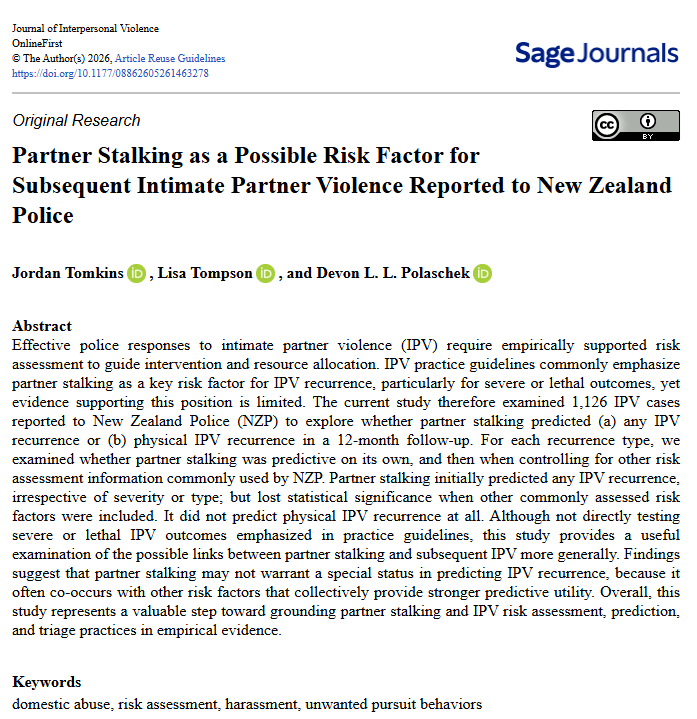
We’re pleased to share that Dr Jordan Tomkins, a Consultant at Cordis Bright, has co-authored a new study published in the Journal of Interpersonal Violence. This study formed part of Jordan’s doctoral research, which investigated stalking in domestic abuse cases in New Zealand.
For this study, the team reviewed incident reports for over 1,000 IPV cases reported to New Zealand Police. Their analysis found that stalking initially predicted IPV recurrence, regardless of severity or type. However, once other commonly assessed risk factors were included in this model, stalking no longer made a statistically significant contribution to predicting IPV recurrence. Further, stalking did not predict the recurrence of physical IPV at all. In contrast to many practice guidelines internationally, these findings suggest that stalking may not represent a ‘special status’ factor for predicting subsequent IPV reported to police, as stalking often co-occurs with other, well-established risk factors that provide stronger predictive value.
Read the full, open-access study here.
At Cordis Bright, we are committed to producing robust and practically relevant evidence to support effective risk assessment of, and responses to, stalking and/or domestic abuse – with recent work including feasibility studies of both the Drive Partnership’s Restart Programme and the Emotion Coaching programme delivered by Solace Women’s Aid.
If you’d like to discuss how our research and evaluation expertise could support your work, please do get in touch.